

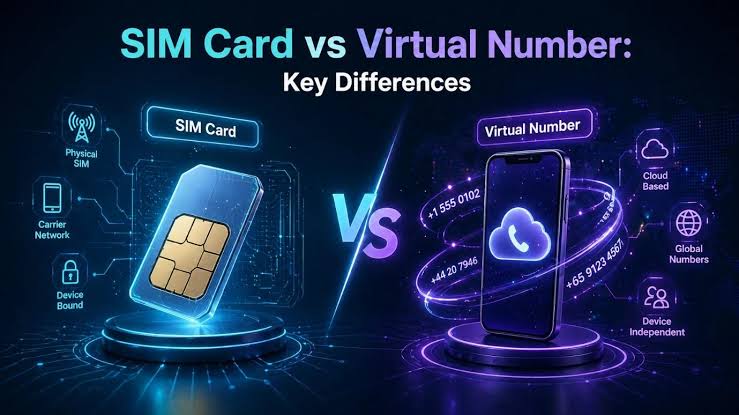
A practical comparison for anyone who needs to verify accounts, test OTP flows, or scale sign-ups without buying a drawer full of SIM cards.
Anyone building or marketing a product that touches phone verification eventually runs into the same operational question: what’s the most efficient way to get working phone numbers for testing and account creation, without turning it into a logistics project? For most teams, the answer has shifted toward a virtual number for instant SMS instead of a physical SIM card. Here’s a side-by-side look at why.
The Core Difference
A physical SIM card is registered to a real person or business, tied to a carrier contract, and capable of making calls, sending texts, and receiving data — a full mobile line. A virtual number, by contrast, is a cloud-hosted line rented for a short session with one job: receive an incoming SMS and route it to a private dashboard. It can’t call out, and in most implementations it can’t text out either. That narrow scope is exactly what makes it fast, cheap, and disposable at scale.
Head-to-Head Comparison
| Factor | Virtual Number | Physical SIM Card |
|---|---|---|
| Setup time | Under a minute | Hours to days, plus ID checks |
| Cost per verification | From roughly $0.05 per SMS | Monthly plan or prepaid top-up, regardless of use |
| Scalability | Request as many as needed, on demand, via dashboard or API | Limited by how many physical SIMs can be bought and managed |
| Country coverage | Often 100+ countries from a single account | Limited to what’s locally available or importable |
| Automation | Scriptable via developer API | Manual handling required |
How the Delivery Actually Works
Behind a virtual number service sits a network of carrier-connected numbers kept live across a large pool of countries. Requesting one doesn’t create a brand-new line — it reserves an already-active number from that pool exclusively for the session, which is why delivery is typically measured in seconds rather than minutes.
1. Select platform + country — choose the service being verified and the country the number should come from.
2. Number reserved — a short window, typically 15–20 minutes, opens for that session only.
3. Enter it in the target app — used exactly like a real number to request the code.
4. Code delivered — routed to the dashboard (or API response) within seconds.
5. Automatic refund — if nothing arrives before the window closes, most services credit the balance back automatically.
Where This Fits Into a Developer Workflow
QA teams and developers building anything that sends SMS codes need real, working numbers on demand — not a handful of personal lines shared across the team. A developer API for requesting numbers and reading incoming SMS turns this into something that can be scripted and run as part of an automated test suite rather than done by hand every time a flow needs checking.
This matters most in three common scenarios:
- OTP flow testing — verifying that a product’s own SMS delivery, formatting, and expiry logic behave correctly across regions.
- Load and regression testing — requesting multiple numbers in parallel to simulate real sign-up traffic.
- Region-specific QA — confirming that a sign-up flow behaves correctly for users in different countries, using a local number from each one.
Where This Fits Into a Marketing Workflow
Marketers and online sellers running several storefronts, ad accounts, or campaign-specific profiles face a similar operational problem: most platforms cap how many accounts a single phone number can verify. Buying and managing physical SIMs for each account doesn’t scale — a fresh virtual number per account does, without the overhead of physical hardware or carrier contracts.
The same logic applies to community managers running multiple verified profiles on the same platform, or teams testing region-locked campaigns that require a local number from a specific country.
Which Platforms Are Typically Supported
Across most providers’ catalogs, the same core set of apps shows up: Telegram, WhatsApp, Google, Instagram, Tinder, TikTok, Discord, X (Twitter), LinkedIn, Reddit, and OpenAI’s ChatGPT. If a specific app isn’t listed by name, it’s often still supported somewhere in the broader catalog — most services let you search by platform rather than scrolling through categories manually.
Does the Country Choice Actually Affect Success Rate?
Yes. Some platforms are more aggressive about flagging certain regions, so matching the number’s country to where the account will actually be used generally improves acceptance. US and UK numbers tend to have the broadest acceptance across mainstream apps, while region-specific platforms often verify faster with a local number from that same country. Since unused requests are typically refunded automatically, there’s little cost to testing a different country if one gets rejected.
Is This Legal to Use for Testing and Marketing Purposes?
Yes — using a virtual number to receive a verification code is legal in the overwhelming majority of countries. It’s a different category of phone line, not a loophole around any law. What determines legitimate use is intent: testing an OTP flow or managing multiple legitimate business accounts is normal, while using a disposable number to spam, commit fraud, or evade a platform’s ban is not, and no legitimate provider condones that kind of use.
One Important Limitation
A virtual number is single-use by design, so it’s not the right tool for an account that will need SMS-based account recovery later. For anything meant to persist — a real customer-facing account, for example — pair the initial verification with two-factor authentication or a recovery email rather than relying on the same rented number being available again.
Frequently Asked Questions
Can this be fully automated for bulk testing?
Yes — developer APIs exist specifically for requesting numbers and reading incoming SMS programmatically, which is what makes bulk or automated QA workflows practical.
How many countries are typically available?
Most catalogs span well over a hundred countries from a single account.
What happens if a request doesn’t receive a code?
Most providers refund the balance automatically if no SMS arrives within the session window, with no support ticket required.
Bottom Line
For one-off personal use, a virtual number is a privacy convenience. For developers and marketers operating at any scale, it’s closer to essential infrastructure — a virtual number for OTP verification replaces the logistics of physical SIM cards with something scriptable, instant, and available across a huge range of countries on demand.
