

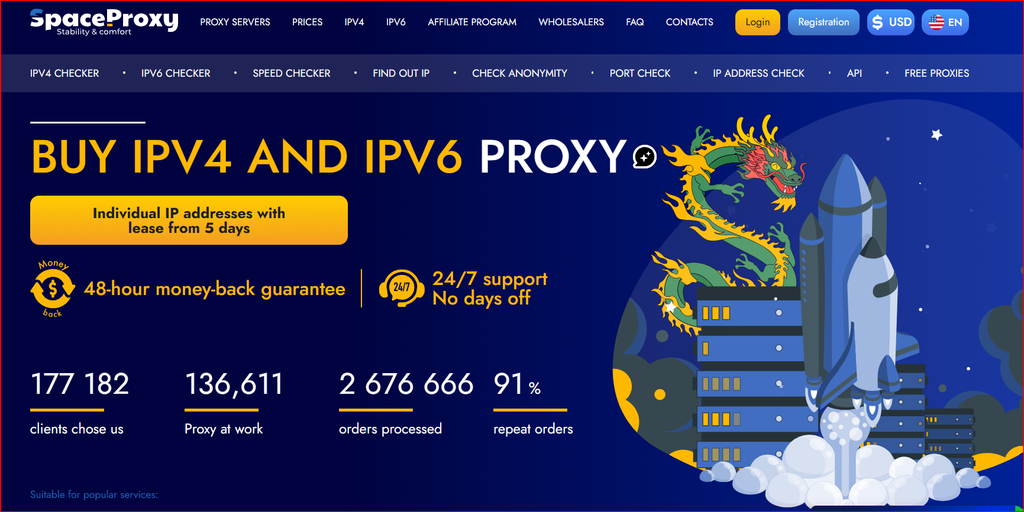
I reviewed SpaceProxy for sneaker bots and limited drops as a connectivity product for legitimate shopping automation and monitoring workflows where retailer rules allow it. I focused on static IPv4 options, subnet diversity, HTTP/SOCKS5 support, short rental terms, the provider speed and checker tools, API access and the economics of testing a small proxy batch before a release. I did not assume that a proxy guarantees checkout success or permission to automate a retailer.
What I Tested
The first thing I tested conceptually was whether the product model matches a short-lived launch. SpaceProxy allows rental from five days, which is useful when a project revolves around a release window rather than a permanent monthly workload. I also reviewed individual versus shared IPv4, country and city selection, subnet controls, the API, the provider checker utilities, unlimited traffic claims and the published stream allowance.
For sneaker or limited-product monitoring, I care more about stability and clean organization than about marketing claims such as “fastest.” A static proxy should connect consistently, return the intended region, and remain mapped to the same task long enough for me to diagnose failures. If the workflow is allowed by the retailer, that predictability can help separate network problems from application problems.
I did not fabricate checkout success rates, latency numbers or retailer compatibility lists. Stores change defenses frequently, and permission to automate depends on each retailer. The correct test is a small batch on the exact target, within its terms, before buying hundreds of addresses.
Individual IPv4 vs Shared IPv4
For any authenticated shopping session or cart workflow, I would test individual IPv4 first. It gives me a single-customer endpoint, which is easier to document and less exposed to whatever other shared users may have done from the same address. The extra cost is small compared with the value of a predictable test environment.
Shared IPv4 can work for public inventory monitoring, product-page checks or price observation where no sensitive session is involved. It is cheaper and can be enough for tasks that simply need a regional view. I would not mix shared and individual endpoints in the same benchmark because the reputation characteristics are different.
IPv6 looks attractive on price, but many commerce workflows are built around IPv4 assumptions. I would only use IPv6 after the exact retailer, bot framework or browser automation stack passes a compatibility test.
Subnets and Pool Design
SpaceProxy advertises access to more than 1,900 networks and subnets. For a larger permitted monitoring project, subnet diversity gives me another lever when designing a pool. I would rather distribute tasks across several networks than place every worker in one small subnet, especially when I am testing multiple regions or retailers.
That does not mean more subnets automatically produce better results. A disciplined pool has a clear purpose for each endpoint. I label the IP, country, city, subnet, protocol, assigned task and expiration date. If one endpoint fails, I can remove it without disrupting the entire pool.
For small projects, I would not overengineer. Ten well-documented individual IPv4 proxies can be easier to manage than hundreds of addresses with no assignment strategy.
Using the Built-In Checker Tools
SpaceProxy exposes several web utilities, including IPv4 and IPv6 checking, speed checking, IP lookup, anonymity checks and port checking. I use tools like these as a first validation step after purchase. I confirm that the endpoint responds, that the detected country is reasonable, and that the browser or application is actually sending traffic through the proxy.
A single speed test is not enough to predict performance during a product release. I would repeat the test at different times, then compare with the real target page. Retailer response time, DNS, local ISP routing and application design all affect the experience. The checker is useful for finding obvious problems, not for promising checkout performance.
My Test Workflow Before a Release
I begin several days before the event. I purchase a small five-day batch, import the proxies into the permitted monitoring or browser tool, and run basic connectivity checks. Then I open the actual product site manually and verify that pages load, localization is correct, and the retailer does not immediately reject the endpoint. I avoid aggressive request rates during this validation.
Next, I assign one proxy per worker or browser profile where the software architecture supports it. I record errors by proxy so I can identify whether failures cluster on one address, one subnet or one destination. If the retailer provides an official API or feed, I prefer that over scraping.
On the event day, I prioritize reliability over changing configuration at the last minute. If an endpoint has been stable in testing, I keep it. A launch is a poor time to rotate protocol, browser version, IP and task settings simultaneously.
HTTP/SOCKS5 and API
SpaceProxy supports HTTP and SOCKS5, which covers most browser and automation tools. SOCKS5 can be useful for applications that need a more general proxy transport, while HTTP is often simpler for browser-based monitoring. I use whichever protocol the software officially supports best.
The API becomes more interesting at scale. Instead of copying proxy strings manually, a team can synchronize inventory, expiration dates or order data into an internal tool. I would still add validation and error handling around the integration because a working API call does not guarantee the destination accepts the proxy.
Pricing for Drop Monitoring and Short Campaigns
Before ordering, I would verify the live details on the SpaceProxy IPv4 proxy page.
| Proxy Type | 5 Days | 30 Days | 90 Days | 360 Days | Use Case |
|---|---|---|---|---|---|
| Shared IPv4 | $0.67/IP | $0.99/IP | $2.97/IP | $11.88/IP | Monitoring / low-risk browsing |
| Individual IPv4 (1-20) | $0.96/IP | $1.77/IP | $5.31/IP | $21.24/IP | Stable sessions and tests |
| Individual IPv4 (90-1000) | $0.83/IP | $1.50/IP | $4.50/IP | $18.00/IP | Larger proxy pools |
| IPv6/32 (1-99) | $0.10/IP | $0.51/IP | $1.53/IP | $6.12/IP | Only compatible targets |
Pricing snapshot checked in September 2026. Provider prices, discounts, locations and terms may change.
What I Liked
The five-day rental option is especially well suited to short campaigns. I also like the combination of individual IPv4, city and subnet selection, automated activation, API access, checker utilities, unlimited traffic positioning and the ability to start with one IP rather than a large bundle.
For a small legitimate monitoring project, the service is easy to understand. I do not need to buy bandwidth by the gigabyte or learn a rotating-gateway system. I can assign a static address to a task and measure whether it works.
What I Would Improve
I would publish more English documentation for commerce monitoring and event-based workloads, especially examples that emphasize retailer terms, request pacing and small-batch testing. That would make the product easier to use responsibly.
I would also expose clearer real-time availability by city and subnet before checkout. Limited releases are time-sensitive, so knowing inventory before ordering would reduce setup friction.
FAQ
Does a proxy guarantee success on a sneaker drop? No. Retailer rules, account status, checkout systems, bot defenses, network latency and inventory all matter.
Which SpaceProxy product would I test first? Individual IPv4 for stable authenticated or session-based workflows, shared IPv4 for low-risk public monitoring.
Can I rent for only a few days? Yes. SpaceProxy advertises rental periods starting from five days.
Does SpaceProxy support SOCKS5? Yes, along with HTTP proxy formats.
Is IPv6 a cheaper alternative? It is much cheaper, but I would only use it where the retailer and software fully support IPv6.
Conclusion
My final take is that SpaceProxy is most interesting for short, controlled monitoring or shopping-automation tests where static IPv4, subnet choice and a five-day rental window are more useful than a huge rotating residential pool. I would validate a small batch on the exact permitted target first, keep request rates reasonable, and scale only after the workflow is stable. For that kind of disciplined test, the SpaceProxy sneaker proxy setup is a straightforward starting point with predictable pricing and enough location controls for a serious pre-release check.
