

Anyone who has looked at a Certificate of Analysis for a research peptide will have seen two abbreviations come up again and again: HPLC and MS. High-performance liquid chromatography and mass spectrometry are the workhorses of peptide quality control, and they are often mentioned together as if they were a single test. They are not. Each technique answers a different question about a peptide batch, and understanding the difference helps a laboratory read documentation with a critical eye. This article explains, in plain terms, what each method does, what it can and cannot tell you, and why the two are most useful when used together.
Two questions every lab needs answered
When a research group receives a batch of peptide, there are two basic things it needs to know before the material goes anywhere near an experiment. The first is purity: how much of the material in the vial is the intended peptide, and how much is something else, such as truncated sequences, synthesis by-products or other impurities? The second is identity: is the main component actually the peptide it is supposed to be?
These questions sound similar but they are quite different. A sample can be very pure but contain the wrong molecule. Equally, a sample can contain the right molecule but with a significant proportion of impurities. A complete quality picture needs both questions answered, and that is precisely where HPLC and mass spectrometry divide the work.
For buyers of research peptides Australia-wide, this distinction is more than academic. It determines whether the documentation that comes with a batch actually supports the claims made about it. The infographic below summarises how the two techniques compare and how they combine on a Certificate of Analysis.
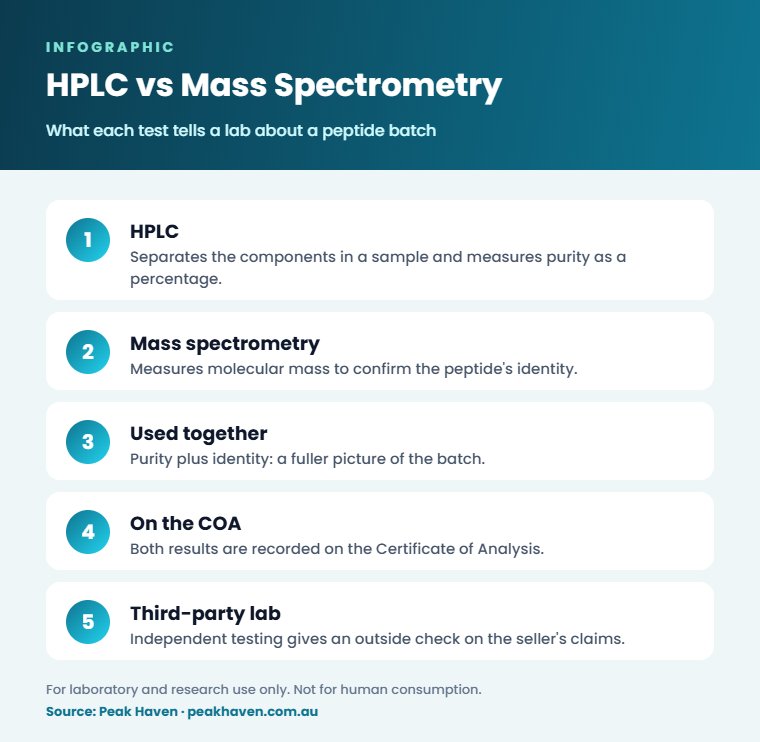
Infographic: Peak Haven
HPLC: separating components to measure purity
High-performance liquid chromatography is a separation technique. A small amount of the sample is dissolved and pushed under high pressure through a narrow column packed with fine particles. Different molecules in the sample interact with the column material to different degrees, so they travel through it at different speeds and emerge, or “elute”, at different times.
As each component leaves the column, it passes a detector, usually one that measures ultraviolet absorbance. The detector output is plotted as a chromatogram: a graph with time along the horizontal axis and signal strength on the vertical axis. Each component appears as a peak.
How purity is calculated
In a well-run analysis, the intended peptide produces one main peak, and any impurities produce smaller peaks elsewhere on the chromatogram. Purity is commonly reported as the area of the main peak expressed as a percentage of the total area of all detected peaks. If the main peak accounts for almost all the detected signal, the batch is reported as highly pure.
What HPLC does well
- It separates closely related compounds, including many synthesis by-products.
- It produces a clear, quantitative purity percentage.
- It is reproducible, so results can be compared across batches.
- The chromatogram itself is a useful visual record of the batch.
What HPLC cannot do on its own
HPLC tells you how much of the sample sits in the main peak, but on its own it does not confirm what that peak actually is. The timing of a peak (its retention time) can be compared with a known reference, but similar molecules can behave in similar ways. This is the gap that mass spectrometry fills.
Mass spectrometry: measuring molecular mass to confirm identity
Mass spectrometry works on a completely different principle. Instead of separating molecules by how they interact with a column, it measures their mass. The sample is converted into charged particles (ions), which are then sorted according to their mass-to-charge ratio. The instrument records which ions are present and in what relative amounts, producing a mass spectrum.
Every peptide has a theoretical molecular mass that can be calculated precisely from its amino acid sequence. When the measured mass in the spectrum matches the theoretical mass within an acceptable tolerance, that is strong evidence the sample contains the intended peptide.
What mass spectrometry does well
- It confirms molecular identity by matching measured and expected mass.
- It can detect if the molecule is missing a residue or carries an unexpected modification, because those changes alter the mass.
- It is highly sensitive and needs only small amounts of sample.
What mass spectrometry cannot do on its own
A standard mass spectrum is not designed to give a precise purity percentage in the way HPLC does. Different molecules can ionise with different efficiencies, so the relative heights of signals do not always reflect relative amounts. A mass spectrum can show that the right molecule is present, but not necessarily how much of the sample it makes up.
Side by side: what each test tells you
QuestionHPLCMass spectrometry How does it work?Separates components as they pass through a columnMeasures the mass-to-charge ratio of ions Main outputChromatogram with peaks over timeMass spectrum with signals by mass Key resultPurity percentageConfirmation of molecular identity StrengthQuantifies impuritiesVerifies the molecule is the right one LimitationDoes not confirm identity on its ownNot designed for precise purity figures Why the combination matters
Used together, HPLC and mass spectrometry give a far more complete picture than either does alone. HPLC answers “how pure is it?” and mass spectrometry answers “is it the right molecule?” When both results are satisfactory, a lab can be confident that the batch is both the intended peptide and largely free of impurities.
The two techniques are often physically combined in a method known as LC-MS, where the output of a liquid chromatography column feeds directly into a mass spectrometer. This allows each separated peak to be identified by mass, linking purity and identity information in a single run. Whether the tests are run separately or in combination, the principle is the same: purity plus identity equals a well-characterised batch.
Where the results appear: the Certificate of Analysis
For most labs, the results of HPLC and mass spectrometry are encountered on a Certificate of Analysis (COA). A COA summarises the testing performed on a specific batch and should be read as a record tied to that batch alone. Key items to look for include:
- Batch or lot number: this should match the label on the vial in your freezer.
- Test methods: the COA should state whether HPLC, mass spectrometry or both were used.
- Purity result: usually expressed as a percentage from HPLC, alongside the specification it was tested against.
- Identity result: the observed molecular mass compared with the expected value.
- Date and laboratory: when the testing was carried out and by whom.
- Supporting data: some COAs include the chromatogram and spectrum themselves, which allows a more detailed review.
A COA that reports a purity percentage but gives no identity confirmation, or one that does not name a test method, provides less assurance than one that covers both. Labs are entitled to ask a supplier for clarification when a document is incomplete.
Third-party testing as an independent check
Who performs the testing matters as much as which tests are run. When a supplier tests its own products, the results may be accurate, but they are not independent. A third-party laboratory, with no stake in the sale, provides an additional layer of assurance that the results reflect the material rather than the seller’s expectations.
Third-party testing is increasingly expected in the Australian research supply market. As one example, Peak Haven, which sells research peptides and laboratory supplies to the Australian research community, says every batch is independently tested by a third-party laboratory using HPLC and/or mass spectrometry. The company advertises purity of at least 99 per cent, HPLC verified, and says Certificates of Analysis are available on request through a batch documentation library. It labels its products for laboratory and research use only and not for human consumption.
Claims like these are most useful when a lab can match them to a specific document. Before relying on any purity or identity figure, ask for the COA for the exact batch being supplied and check it against the points above.
Practical tips for reading test results
- Match the batch number every time. A COA for a different batch, however impressive, says nothing about the vial you received.
- Check both questions are answered. Look for a purity figure and an identity confirmation.
- Note the testing laboratory. Independent testing carries more weight than in-house results alone.
- Keep the COA with your records. File it alongside the purchase order and storage log so it is available for audits or publication queries.
- Store the material correctly. Test results describe the batch at the time of analysis; correct storage helps the material stay consistent with that description.
Common misreadings to avoid
Even experienced researchers can misread analytical documentation when they are in a hurry. A few traps come up often. One is assuming that a high HPLC purity figure also proves identity, when it only describes how much of the sample sits in the main peak. Another is treating a mass spectrum with the right signal as proof of high purity, when impurities may simply be less visible in that type of data. A third is overlooking the date of analysis: a COA describes the batch when it was tested, not necessarily its condition after months of storage. Reading each result for what it actually measures keeps interpretation honest and helps a lab ask better questions of its suppliers.
The bottom line
HPLC and mass spectrometry are complementary tools. HPLC separates a sample to show how pure it is, while mass spectrometry weighs the molecules to confirm what they are. On a Certificate of Analysis, the two together give a laboratory the confidence it needs that a batch is both correct and clean. Combined with independent third-party testing and good record keeping, they form the foundation of quality assurance for any lab working with research peptides.
