

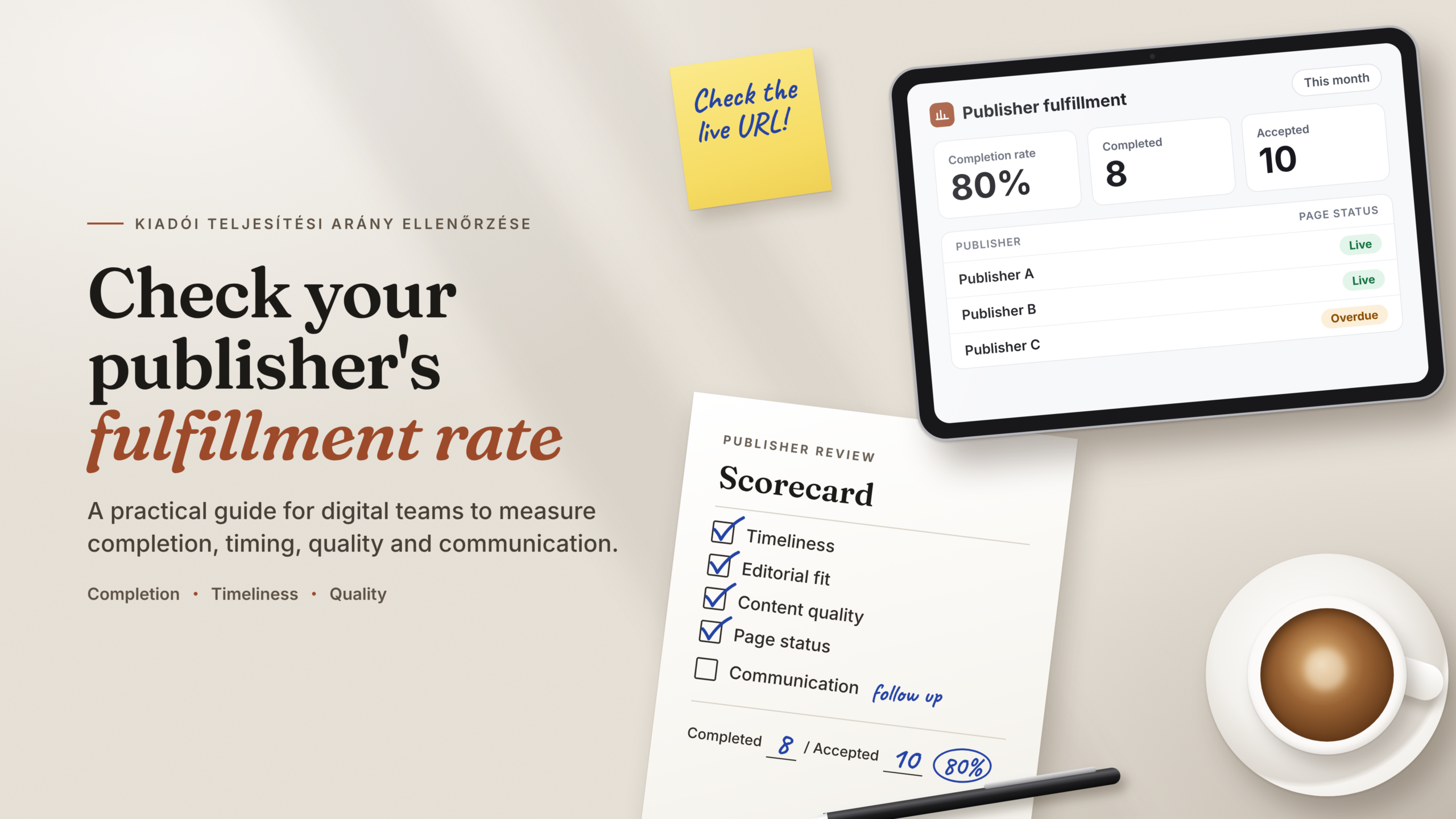
For a website that publishes news, sports coverage, or technical guides, a publishing partnership is only useful if agreed work arrives on time and meets the brief. The Hungarian phrase kiadói teljesítési arány ellenőrzése means checking a publisher’s fulfillment rate: assessing how reliably a publisher completes the work it accepts. It is a useful idea for anyone managing guest articles, sponsored content, or a wider editorial calendar, because a low delivery rate can create delays well beyond one missed post.
What a Publisher Fulfillment Rate Measures
A fulfillment rate is a simple starting point, not a complete quality score. A basic calculation compares the number of assignments completed with the number accepted during a defined period. For example, if a publisher accepts ten placements and completes eight, the completion rate is 80 percent. Teams should decide in advance what counts as completed: publication by the agreed date, compliance with the content brief, and a live page that can be checked.
It is also important to separate cancellations from overdue work. A publisher who declines an unsuitable assignment before accepting it is different from one who confirms a placement and then fails to deliver. Tracking those outcomes separately gives a more accurate picture of reliability and helps identify where a process needs improvement.
Why the Number Needs Context
A high completion rate does not automatically make a publisher a strong fit. A site may publish every assigned article but provide little audience relevance, unclear editorial standards, or a poor match for the subject. Conversely, a publisher may have a few delays caused by a temporary staffing issue while still offering a valuable audience and transparent communication.
Consider the full record alongside the percentage:
Timeliness: Were agreed dates met, and were delays communicated early?
Editorial fit: Does the site regularly cover the relevant topic, such as local sport, software, or technology policy?
Content quality: Is the published work accurate, readable, and consistent with the agreed brief?
Page status: Is the content live and accessible, and does it remain available after publication?
Communication: Are questions, edits, and changes handled clearly?
These checks matter especially to news and sports publishers, where timing can determine whether an article is useful. A match preview delivered after kick-off, or a product explainer published after a software release, may technically be complete but miss its purpose.
Build a Consistent Review Process
Start with a shared record for each assignment. Include the date it was accepted, the promised publication window, the final URL, any revisions requested, and the outcome. Use the same definitions for every publisher so that comparisons are fair. A short monthly review can reveal patterns that are easy to miss when teams only look at individual orders.
Set a reasonable observation period before drawing conclusions. A publisher with only two assignments has a small sample, so one cancellation can distort the percentage. Note the number of completed jobs beside the rate, and avoid treating a handful of results as a definitive ranking. If a partner’s performance changes, review the recent record rather than relying solely on an older average.
When a delivery is late, document what happened and ask for a clear revised date. If the brief itself was incomplete or changed after acceptance, record that too. Good measurement should help both sides identify friction, not simply assign blame. Clear specifications, realistic deadlines, and a single contact person can improve performance across a campaign.
Research Publishers Before Assigning Work
Pre-assignment research reduces the chance of relying on a rate that looks strong but hides a weak fit. Check the site’s recent articles, subject focus, publishing cadence, and whether its audience aligns with the intended readers. For link-building campaigns, assess the relevance and credibility of a potential placement rather than treating a backlink as a standalone deliverable.
Teams planning guest post publisher research and coordination may also need support finding and assessing specialists. Osdire’s guide to hiring a link-building freelancer outlines skills, costs, and vetting considerations. That kind of preparation can help define responsibilities: who researches publisher options, who checks the content, and who confirms that the final placement meets the brief.
For teams comparing marketplace workflows, iCopify’s Hungarian page is another point to review. Treat any platform as one part of the research process: clarify what information is available, confirm the terms that apply, and evaluate publishers against your own editorial and audience requirements.
Use the Results to Improve Planning
A publisher’s fulfillment record can inform how much lead time to allow and how much work to assign. Reliable partners may suit time-sensitive projects, while newer or less-tested contacts can begin with a smaller assignment. This is not a substitute for reviewing every published page; it is a way to manage uncertainty before it affects a campaign.
Keep the scorecard practical. Track completion, timing, quality, and communication, then revisit the criteria as your publishing needs change. A useful rate check combines a clear calculation with editorial judgment. That balance helps digital teams choose partners more carefully, spot operational problems sooner, and keep content plans dependable without reducing publishing quality to a single number.
